



Tours in Amman


Cruising to Amman in a group?
Skip the crowded ship excursion bus. One dedicated planner will design a private shore experience around exactly what your group wants — coordinated from first enquiry to the moment you're back on board. More memorable, more flexible, and more affordable than you might expect. Spend less time organising, more time enjoying.
Explore Group Travel →Cruising to Amman
Jordan occupies a singular position in the ancient world — a land bridge between the great civilisations of Egypt, Mesopotamia, and the Levant, crossed by trade routes, armies, and pilgrims for millennia. From the port of Aqaba on the Red Sea, cruise guests can reach two entirely different experiences: Petra, the Nabataean rock city that is among the most visually stunning archaeological sites on earth, and Amman, a capital city built across seven hills where Roman columns and Ottoman architecture stand against a backdrop of modern coffee shops and design galleries. The country is known for its warm hospitality, relative stability in a complex region, and a culinary tradition built on lamb, herbs, flatbread, and the fermented yoghurt dishes that define Jordanian home cooking.
Top things to do in Amman on a cruise stopover
Petra: The Rose-Red City of the Nabataeans
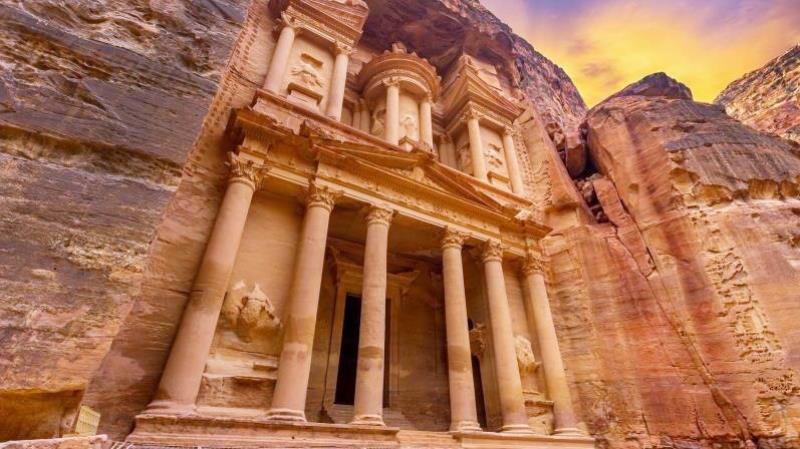
Petra is one of those rare places where the reality exceeds expectation. The approach through the Siq — a narrow, kilometre-long slot canyon with walls rising 80 metres overhead — builds anticipation before the Treasury (Al-Khazneh) appears at the canyon's end with theatrical effect. This is only the beginning. Beyond the Treasury, Petra unfolds across a vast valley: Royal Tombs cut directly into cliff faces, a Roman-era colonnaded street, a 1st-century AD amphitheatre, and the Monastery (Ad-Deir), reachable by 800 steps, commanding views across the surrounding desert. The Nabataeans carved an entire city from rose-coloured sandstone between the 4th century BC and 1st century AD. The site was unknown to the Western world until 1812.
Amman's Roman Theatre and Hashemite Plaza
In the centre of Amman's downtown district, a Roman theatre cut into a hillside in the 2nd century AD seats 6,000 spectators and remains in near-perfect condition. The theatre forms the anchor of Hashemite Plaza, a public space surrounded by the Odeon (a smaller Roman performance venue), the Jordan Museum of Popular Traditions, and the Folklore Museum. Together they form an accessible cultural cluster at the base of Amman's oldest hill, where the original Ammonite and Roman city stood. The theatre's upper tiers offer a fine view over Amman's dense, white-stone cityscape — a city that has grown from 20,000 people in 1948 to over 4 million today.
The Amman Citadel and the Jordan Museum
Perched atop Jebel al-Qal'a, the highest of Amman's hills, the Citadel holds 7,000 years of layered occupation: Bronze Age temples, Iron Age settlements, a Roman Temple of Hercules whose massive hand fragment remains, a Byzantine church, and the Umayyad Palace complex built in the early Islamic period. The adjacent Jordan Museum houses the best single collection of Jordanian antiquities, including the oldest known statues of the human form (the Ain Ghazal statues, c. 7250 BC) and original Dead Sea Scroll fragments. Together, the Citadel and museum provide a genuinely world-class introduction to Jordan's long history.
Rainbow Street and Jabal Amman
The neighbourhood of Jabal Amman — particularly the stretch of Rainbow Street running along the first circle — presents a different face of the capital: renovated Ottoman-era stone houses converted into coffee shops, bookshops, galleries, and restaurants serving modern interpretations of Jordanian cuisine. The area is walkable, culturally vivid, and gives a sense of the city as a lived-in, cosmopolitan place rather than a purely historical one. Friday mornings bring an organic market; evenings see outdoor cafe seating fill with a mix of locals and visitors. The neighbourhood sits a short distance from the downtown Roman Theatre.
Jordanian Cuisine: From Street Food to Mansaf
Amman's food culture ranges from street-side falafel stands — operating from before dawn — to restaurants dedicated to regional specialities rarely encountered outside the country. The central souq area near downtown Amman offers fresh-pressed juices (pomegranate in season is exceptional), ka'ak bread rings sold from baskets, and the fragrant aromas of za'atar, sumac, and dried herbs. For a sit-down meal, mansaf is the defining experience: lamb simmered in jameed (dried, fermented goat yoghurt reconstituted into a rich sauce), served over rice and garnished with almonds and parsley. It is simultaneously simple and deeply complex in flavour.
Wadi Musa: Gateway to Petra
Wadi Musa is the small town immediately adjacent to Petra's entrance and the base for any visit to the site. The Petra Visitor Centre at Wadi Musa provides orientation maps and contextual exhibits before entering. Local restaurants in the town serve straightforward Jordanian food — hummus, grilled meats, fresh bread — at prices well below those of the vendors inside Petra itself. The town's market offers locally made silver jewellery, sand-filled glass bottles, and Bedouin-style textiles. Visiting Wadi Musa before or after Petra adds a dimension to the day beyond the archaeological site alone.
Amman travel tips
Wear Layers and Carry Water at Petra. Petra's climate can surprise visitors. Mornings in the site can be cool, even cold in winter months, while midday temperatures rise sharply in summer. The main path from the Siq entrance to the Monastery involves significant walking — a minimum of 8–10 kilometres if you explore the key areas. Wear comfortable, closed-toe shoes with grip (no heels; sandals without straps are impractical), carry at least 1.5 litres of water per person, and wear a sun hat. Sunscreen is essential from April onwards. Water is sold inside the site but at a premium — fill up before entering.
Enter Petra Early for the Best Experience. Petra opens at 6am and the first two hours see dramatically fewer visitors than mid-morning onwards. The Treasury, in particular, is most striking in the morning light when the eastern sun illuminates the carved facade directly. Walking the Siq in early morning quiet, before tour groups arrive, is an experience worth planning for. The site also becomes noticeably hotter as the day progresses, making an early start more comfortable as well as more atmospheric.
Dress Respectfully Across Jordan. Jordan is a moderate Muslim-majority country where modest dress is appreciated, particularly outside the main tourist sites. In Amman's older districts and markets, covering arms and avoiding very short hemlines is both respectful and comfortable. At Petra, practical dress and modesty align naturally — lightweight long trousers work well for the terrain and local norms simultaneously. Mosques require shoes to be removed and head coverings for women. Beachwear is appropriate only at the beach in Aqaba.
The Jordan Pass: Know What It Covers. The Jordan Pass combines a Jordanian tourist visa (for most nationalities) with entry to over 40 sites including Petra, the Citadel, and the Roman Theatre. For cruise passengers, the visa component may be redundant as Jordan offers free arrival visas at Aqaba for many nationalities. However, Petra's standalone entrance fee is significant — the Jordan Pass's inclusion of Petra entry often justifies the purchase price alone. Check current terms and eligibility before travel and purchase in advance online.
Carry Dinars for Markets and Small Vendors. The Jordanian Dinar (JOD) is a strong currency — approximately 1.40 USD per dinar as a general guide, though rates vary. Major sites, restaurants, and hotels accept credit cards, but souq markets, small food vendors, and some local transport require cash. US dollars are widely accepted as a secondary currency at tourist-facing businesses. Currency exchange facilities are available at Aqaba port and in central Amman. Exchange counters at ports and airports typically offer less favourable rates than bank branches.
Amman Is Built on Hills — Plan Your Route. Amman's nickname — the City of Seven Hills — is earned. The key sights cluster across different hilltops connected by steep staircases or short road journeys. The downtown Roman Theatre area and the Citadel are close in distance but separated by a stiff uphill climb on foot. Rainbow Street and the first circle sit on a different ridge. Planning the day to avoid unnecessary backtracking between hills saves both time and energy, and the Citadel is best reached directly rather than as part of a walking route from the theatre.
Port Facts Every Cruiser Needs To Know
Amman shore excursion FAQs
Cruise ships visiting Jordan dock at the Port of Aqaba, Jordan's only seaport, located at the northern tip of the Red Sea. Petra is approximately 130 km north of Aqaba (2–2.5 hours by road); Amman is approximately 330 km north (3.5–4 hours). The port has basic facilities; most guests proceed directly to their chosen destination.
The journey from Aqaba to the Petra visitor centre at Wadi Musa takes approximately 2 to 2.5 hours by road in normal conditions. The route is well-maintained. Allow the same duration for the return journey. A round trip of 4–5 hours of driving means a cruise call of at least 10 hours is needed for a meaningful visit to the site itself.
One day is sufficient to see Petra's most significant areas: the Siq, the Treasury, the Royal Tombs, the colonnaded street, and — if energy allows — the Monastery. The Monastery adds approximately 45–60 minutes of stair climbing each way but rewards the effort with dramatic views and fewer visitors. A full, comfortable day inside the site requires 4–5 hours minimum. Arriving early maximises both the time available and the quality of the visit.
Most nationalities can obtain a visa on arrival at Aqaba port, and cruise passengers transiting Jordan for a day excursion are typically eligible for a free single-entry visa. Requirements vary by nationality and can change — confirm current entry requirements with your embassy or consulate before travel. The Jordan Pass, purchased in advance, includes both the Petra entry fee and a visa for eligible nationalities.
Petra involves extensive walking on uneven, rocky terrain under open sun. Comfortable closed-toe shoes with real grip are essential — sandals are manageable but not ideal. Wear lightweight, breathable clothing that covers shoulders and knees (both for sun protection and cultural respect). A sun hat and sunscreen are essential from March through October. A small daypack carrying water, snacks, and a light layer for the cooler canyon sections makes the visit considerably more comfortable.
Jordan has maintained a reputation as one of the more stable and welcoming countries in the Middle East for international visitors. The main tourist areas — Petra, Amman, Aqaba — receive large numbers of international visitors year-round. Standard travel precautions apply: keep valuables secure, be aware of surroundings in unfamiliar areas, and check current government travel advisories from your home country before departure.
The Jordan Pass is a pre-purchased digital pass combining a Jordanian tourist visa (for eligible nationalities) with entry to over 40 sites including Petra, Jerash, the Citadel, and others. For cruise passengers, the visa component may be redundant if free arrival visas apply at Aqaba. However, Petra's standalone entrance fee is significant, and the Jordan Pass inclusion of Petra entry alone can justify the cost depending on the pass tier selected.
Combining Petra and Amman in a single day from Aqaba is not realistic. The two destinations are 200 km apart from each other, and Petra lies in the opposite direction from Amman. A return journey to Petra alone accounts for 4–5 hours of driving; adding Amman would extend total road time to 10 hours or more. Choose one destination and commit to it fully — both reward focused time.
Aqaba has worthwhile attractions if a full excursion is not the plan. The city has a well-regarded coral reef system accessible to snorkellers directly from the shore — the northern Red Sea has warm, clear water year-round. The Aqaba Fort (Qal'at Aqaba) is a small but historically significant Mamluk castle. The Aqaba Archaeological Museum is compact and informative. The waterfront corniche offers a pleasant walk, and the town has a lively souq.
Jordanians are known for genuine hospitality — accepting an offer of coffee or tea is considered polite, though declining graciously is also perfectly acceptable. When visiting mosques, remove shoes before entering; women should cover their hair. Bargaining is expected in souqs and should remain good-humoured. Public displays of affection are best kept minimal. Always ask permission before photographing local people. Pointing with a single finger is considered impolite; use an open hand instead.
Filters
Select a filter to refine results.
Tour Type
Tour Activity
 Cart
Cart
 USD
USD GBP
GBP AUD
AUD EUR
EUR CAD
CAD