



Tours in Quebec City Quebec


Cruising to Quebec City Quebec in a group?
Skip the crowded ship excursion bus. One dedicated planner will design a private shore experience around exactly what your group wants — coordinated from first enquiry to the moment you're back on board. More memorable, more flexible, and more affordable than you might expect. Spend less time organising, more time enjoying.
Explore Group Travel →Cruising to Quebec City Quebec
Perched on a dramatic cape above the St. Lawrence River, Quebec City is one of the most visually arresting ports in North America. Founded in 1608 by Samuel de Champlain, it remains the only fortified city north of Mexico still encircled by its original stone walls — a distinction that earned it UNESCO World Heritage status in 1985. The city divides neatly into two elevations: the soaring Upper Town, anchored by the iconic Château Frontenac and the sweeping Dufferin Terrace promenade, and the charming Lower Town, where cobbled Rue du Petit-Champlain and the restored Place Royale draw visitors into centuries of colonial history. French is the heartbeat of daily life here — the menus, the street signs, the conversations at the boulangerie — yet English is warmly accommodated wherever visitors venture. For cruise travelers, Quebec City is a rare gift: a walkable, living museum where every laneway tells a story.
Top things to do in Quebec City Quebec on a cruise stopover
Old Quebec — A UNESCO World Heritage City
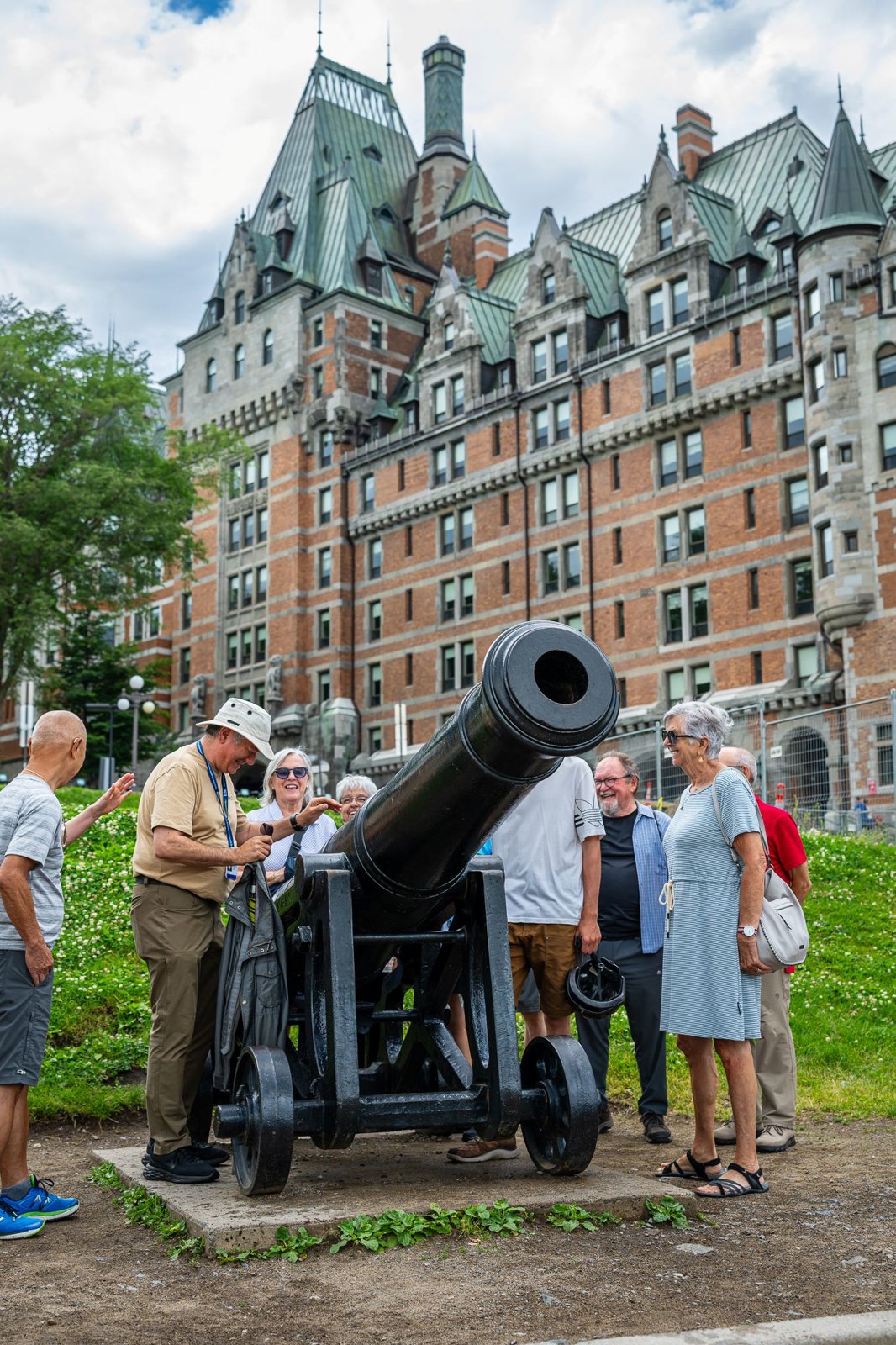
Declared a UNESCO World Heritage Site in 1985, Old Quebec is the most intact colonial city in North America and the only fortified city on the continent north of Mexico. The walls stretch nearly five kilometers around the Upper Town, punctuated by imposing gates — Porte Saint-Jean, Porte Saint-Louis — and crowned with cannons that once aimed at river traffic far below. Walking the ramparts rewards visitors with layered views across rooftops, church spires, and the silver ribbon of the St. Lawrence. History is not curated behind glass here; it lives in the stone buildings, the market squares, and the narrow streets worn smooth by centuries of footsteps. The Grand Shared Tour takes full advantage of this concentrated historic landscape, weaving between the city's most resonant addresses at a pace that allows genuine discovery.
Château Frontenac and Dufferin Terrace
The Château Frontenac, completed in 1893 for the Canadian Pacific Railway, is among the most photographed buildings in the world — its copper-green turrets and cliff-edge setting are inseparable from the Quebec City skyline. The sweeping wooden boardwalk of Dufferin Terrace runs alongside it, offering panoramic views up and down the St. Lawrence that have drawn visitors since the 1830s. Beneath the terrace, archaeologists have uncovered the foundations of the original Château Saint-Louis, governors' residence of New France, and portions are open for exploration. Even without entering the hotel itself, this corner of the city delivers some of the finest urban scenery in Canada — a convergence of history, architecture, and river geography that is difficult to leave.
Quartier Petit-Champlain and Place Royale
Descending by funicular or stairway into the Lower Town reveals Quartier Petit-Champlain — widely regarded as one of the most charming pedestrian streets in North America. The narrow lane is lined with 17th- and 18th-century stone buildings now housing boutiques, galleries, and bistros, with locally designed clothing and Quebec artisanal crafts filling the windows. In summer, flower boxes overflow and musicians set up at street corners, giving the quarter an unhurried festive atmosphere. The adjacent Place Royale, where Samuel de Champlain established the first permanent European settlement in Canada in 1608, frames the quarter with one of the continent's best-preserved concentrations of 17th-century architecture — a genuinely stirring place to stand and take stock of how much history fits into a small stone square.
Plains of Abraham
The site of the 1759 Battle of the Plains of Abraham — the engagement that effectively decided the fate of North America — is today a vast, peaceful urban park stretching along the clifftop west of the Old City. The Musée des Plaines d'Abraham offers compelling exhibits on the battle and its geopolitical aftermath, while the park itself provides walking and cycling paths through open meadow with dramatic views of the St. Lawrence and the south shore. The Martello towers scattered across the grounds are among the best-preserved examples of British defensive architecture anywhere in the world. On clear days, the light over the river from these heights is extraordinary, and the sense of standing on ground where a continent's history pivoted is difficult to shake.
The Fortifications of Quebec
Quebec's fortifications are not simply a backdrop — they are the most complete set of city walls remaining in North America, maintained and interpreted by Parks Canada as a National Historic Site. The circuit walk along the walls passes cannons, powder magazines, gates, and bastions at every turn, placing the city's turbulent military history into vivid physical context. Guided Parks Canada tours run regularly during the summer cruise season and provide depth that a solo walk does not always deliver. The walls effectively frame the Upper Town as its own enclosed world, and the transitions from open rampart to covered gateway to tree-lined boulevard are consistently surprising — a living fortification that still feels purposeful rather than merely decorative.
Montmorency Falls and the Île d'Orléans
Just ten kilometers east of the city, Montmorency Falls drops 83 meters into the St. Lawrence — nearly thirty meters taller than Niagara, though considerably narrower. A cable car, suspension footbridge, and network of stairs and viewing platforms allow visitors to experience the falls from multiple elevations, with mist and rainbows adding drama on any given afternoon. Across the bridge from the falls lies the Île d'Orléans, an agricultural island that has been called the Garden of Quebec since the 17th century — strawberries, ciders, artisanal cheeses, and maple products all produced by farm families whose roots here stretch back generations. The island's rural landscape, a short distance from a major city, is a reminder of how quickly the Quebec countryside reasserts itself beyond the walls.
Quebec City Quebec travel tips
A Little French Goes a Long Way. Locals genuinely appreciate any attempt to engage in French, however basic. Opening with 'Bonjour' and a polite 'Parlez-vous anglais?' before switching to English smooths interactions considerably and reflects well on the traveler. Most residents in tourist-facing roles are fluent in English, but Quebec City's French character is a living culture rather than a performance — engaging with it respectfully changes the quality of the day.
Wear the Right Shoes. Old Quebec is a city of hills, cobblestones, and stairways. Comfortable, well-broken-in walking shoes with good grip are not optional — they are essential. The descent from Upper Town to Lower Town via the Breakneck Stairs (Escalier Casse-Cou) is steep and the steps are irregular; the funicular near Place Royale is a worthwhile alternative for those with mobility concerns or simply tired legs. Expect to cover three to five kilometers of varied terrain over a full day ashore.
Timing the Dufferin Terrace. The terrace in front of the Château Frontenac is most photogenic in the soft light of early morning or in the golden hour before the ship sails. On busy cruise days it can become very crowded by mid-morning; arriving early pays dividends both photographically and practically. The view is worth arranging your day around — but better to see it first than to find it submerged in a hundred other camera operators by noon.
Dining Smarter Than the Crowd. Restaurant quality in Old Quebec is generally high, but popular spots fill quickly on cruise days. Walking three or four streets away from the main tourist circuit reveals neighborhood bistros offering equivalent quality at lower prices and with shorter waits. The market stalls and bakeries around Place Royale are also excellent for provisions — fresh bread, local cheeses, maple pastries — that make a perfect walking lunch without the wait.
Use Canadian Dollars. Canada does not accept euros or US dollars as legal tender; vendors in tourist areas who do accept US dollars apply unfavorable exchange rates. Drawing Canadian dollars from an ATM — several are located along Rue Saint-Jean and near Place d'Armes — or paying by card with no foreign transaction fees is the straightforward approach. Budget for modest admission fees at Parks Canada sites and the funicular.
Dress for the River. Even in July and August, the St. Lawrence River creates its own weather. Temperatures on Dufferin Terrace or atop the ramparts can feel significantly colder than the air temperature reading suggests, particularly when the wind picks up off the water. A light wind-resistant layer in the bag prevents the most common complaint cruise visitors have about their Quebec City day: being underdressed for the riverside chill while perfectly comfortable two streets inland.
Port Facts Every Cruiser Needs To Know
Quebec City Quebec shore excursion FAQs
The cruise terminal at Port de Québec is approximately 1.5 kilometers from the Old Town walls — a flat, easy walk of 15–20 minutes along the waterfront. No significant climbing is involved getting from the pier to the base of Old Town; the elevation change begins once you enter the historic quarter and choose between Lower and Upper Town.
No fluency is required. English is widely spoken in hotels, restaurants, shops, and tourist sites throughout Old Quebec. Basic French greetings are warmly received and genuinely appreciated — 'Bonjour' at the start of any interaction sets a friendly tone that carries through the exchange. The city's French identity is vivid and worth engaging with, but never intimidating for English speakers.
Yes, for most visitors. The historic core — from Petit-Champlain in the Lower Town to the Plains of Abraham at the far western end of the Upper Town — is compact and navigable on foot. The consistent challenge is the change in elevation between the two levels of the city, managed either by the steep Breakneck Stairs or the funicular near Place Royale. Budget more time and energy than a flat city of similar size would require.
Canadian dollars. ATMs in Old Quebec dispense CAD, and most businesses accept major credit cards. US dollars are technically accepted in some tourist-facing shops but always at unfavorable rates. Exchanging currency before going ashore or withdrawing CAD from an ATM on arrival is the practical approach; card payments are reliable throughout the historic district.
The Dufferin Terrace, directly in front of the Château Frontenac, offers the most iconic vantage — the sweep of the St. Lawrence, Lower Town rooftops, and the south shore all visible from one spot. For a different angle on the city, the ramparts near the Citadelle provide views back across the skyline with the river as a backdrop. Both are worth visiting at different times of day, as the light quality changes the composition considerably.
Yes. The falls are about 10 kilometers east of the city and reachable by RTC public bus (routes 800 or 801 from downtown). The site includes a cable car, multiple viewing platforms, a suspension bridge over the falls, and walking trails to the base. The cable car charges admission; the trails are free. Budget at least 90 minutes for a proper visit, plus transit time each way.
Poutine — Quebec's signature dish of French fries topped with fresh cheese curds and gravy — is worth trying from a proper local source rather than a tourist-facing chain. Tourtière (meat pie), maple-glazed pastries, and locally produced cheeses are also emblematic of Quebec's culinary identity. The market stalls near Place Royale and the bakeries along Petit-Champlain are the best starting points for sampling without committing to a full sit-down meal.
Quebec City consistently ranks among the safest cities in North America. Old Town is heavily frequented by visitors and well maintained; solo travelers, families, and groups can move freely without concern. Standard city awareness applies — keep an eye on belongings in crowded areas — but there are no specific safety concerns for cruise visitors exploring the historic quarter independently.
A practical approach is to begin in the Lower Town (Petit-Champlain, Place Royale) before midday crowds arrive, then ascend to the Upper Town for the Château Frontenac, Dufferin Terrace, and the ramparts through the middle of the day, leaving the Plains of Abraham for the afternoon when the westerly light is favorable. This natural flow through the city avoids backtracking and takes advantage of each quarter at its best hour.
The hotel lobby, corridors, and public spaces are open to non-guests and worth a walk-through to appreciate the scale, craftsmanship, and railway-era grandeur of the building. Historical guided tours cover its role as the site of wartime Allied summits, its Canadian Pacific origins, and its architectural evolution. Non-guests are welcome in all public areas; access to guest floors requires a room key. Even a brief visit gives context for why the building has been photographed so relentlessly for over a century.
Filters
Select a filter to refine results.
Tour Type
Tour Activity
 Cart
Cart
 USD
USD GBP
GBP AUD
AUD EUR
EUR CAD
CAD