



Tours in Arica


Cruising to Arica in a group?
Skip the crowded ship excursion bus. One dedicated planner will design a private shore experience around exactly what your group wants — coordinated from first enquiry to the moment you're back on board. More memorable, more flexible, and more affordable than you might expect. Spend less time organising, more time enjoying.
Explore Group Travel →Cruising to Arica
Perched at the very northern tip of Chile, just miles from the Peruvian border, Arica is one of South America's most geographically dramatic cities. Sheltered from weather systems by the Andes to the east and the Atacama Desert to the south, this sun-drenched port earns its nickname - the city of eternal spring - with a near-perfect year-round climate. History here runs extraordinarily deep: the Chinchorro people who inhabited these coastal valleys created the world's oldest known mummies, predating Egypt's pharaonic tradition by two thousand years. From the summit of El Morro, the clifftop fortress-turned-monument where Chile won a decisive battle in the War of the Pacific, the panorama stretches across the city, the Pacific Ocean, and the desert beyond. The port itself is compact and walkable, while the surrounding region reveals pre-Columbian geoglyphs etched into hillsides, fertile Azapa Valley oases, and a culture that blends Andean, indigenous, and Chilean influences in ways unique to this borderland city.
Top things to do in Arica on a cruise stopover
Chinchorro Mummies and the Anthropological Museum
The Museo Arqueológico San Miguel de Azapa holds one of archaeology's most astonishing collections: Chinchorro mummies dating back 7,000 years, making them the oldest artificially mummified human remains ever found. The museum contextualizes these finds within a sophisticated coastal culture that flourished millennia before the great civilizations of Egypt or the Inca Empire. A private city tour anchored here offers expert-guided access to this UNESCO World Heritage-recognized heritage.
El Morro de Arica
The commanding clifftop fortress rising 139 meters above the city is Arica's defining landmark. The site of a pivotal 1880 battle in the War of the Pacific, El Morro is now a monument and military museum with sweeping views over the port, the Pacific Ocean, and the Atacama Desert stretching to the horizon. The climb rewards visitors with one of the most dramatic panoramas on the South American Pacific coast.
The Azapa Valley Oasis
Cutting through the Atacama Desert just inland from the coast, the fertile Azapa Valley is a remarkable ribbon of green orchards and archaeological sites in an otherwise arid landscape. Olive groves, ancient geoglyphs, and pre-Columbian ruins mark a valley that has supported human settlement for millennia. The drive from Arica into the valley is itself a striking visual contrast between Pacific coastline and desert interior.
Pre-Columbian Geoglyphs
The hillsides surrounding Arica and the broader Atacama region are etched with massive geoglyphs created by ancient Andean cultures to mark trade routes and ceremonial sites. Depicting llamas, geometric patterns, and human figures at impressive scale, the geoglyphs of the Lluta and Azapa valleys are visible from the road and can be incorporated into an Azapa Valley excursion as a vivid testament to the region's indigenous heritage.
Historic City Center and the Eiffel-Designed Church
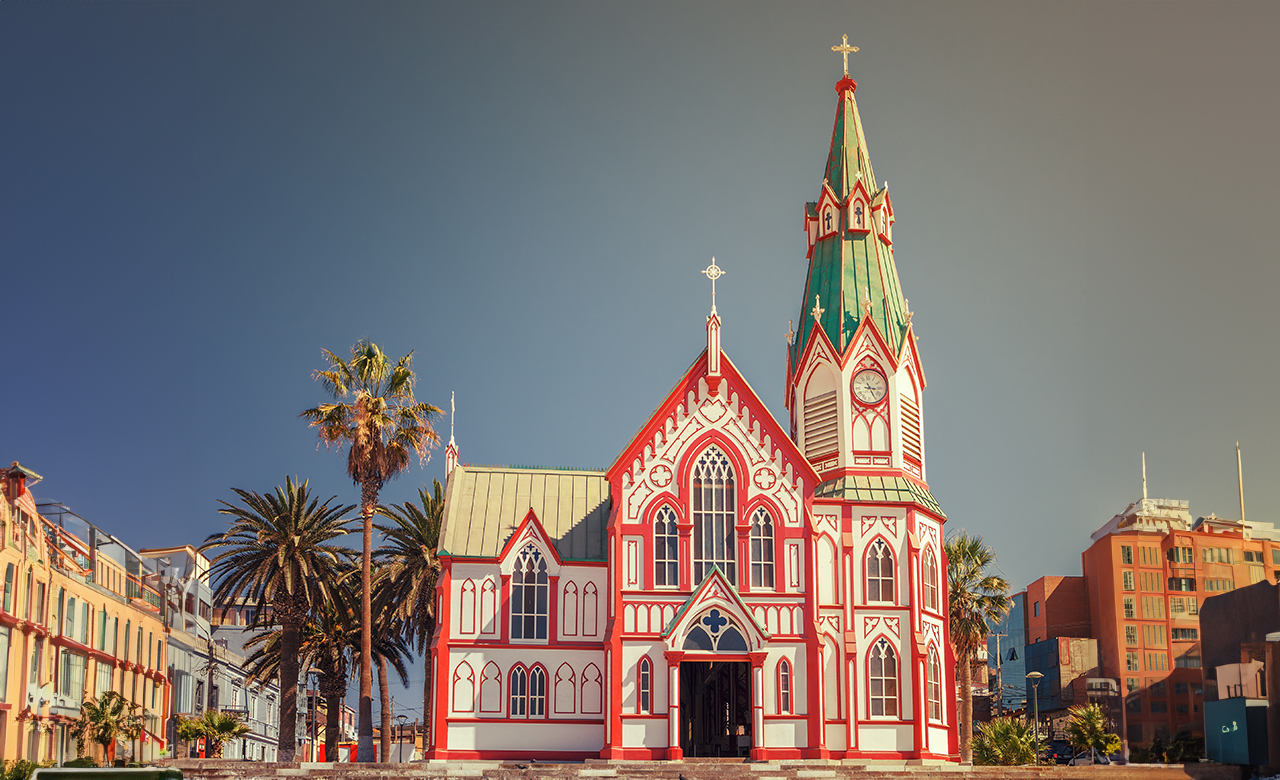
Arica's pedestrianized city center revolves around the Plaza de Armas, anchored by the Church of San Marcos - an iron structure designed by Gustave Eiffel and prefabricated in France before being assembled in Arica. The surrounding streets layer colonial-era buildings, local markets, and the Casa de la Cultura into a compact historic core that reveals the city's layered Peruvian and Chilean history in walkable distance.
Aymara and Andean Cultural Heritage
Arica sits at the gateway between the Pacific coast and the high Andes, making it a living meeting point of coastal Chilean and Aymara highland cultures. Local markets, traditional textiles, and the surrounding archaeological landscape reflect the living heritage of Andean communities who have inhabited this region for thousands of years - a cultural dimension that distinguishes Arica from any other Chilean port.
Arica travel tips
Sun Protection is Non-Negotiable. Arica sits at a latitude where UV radiation is intense, and the near-total absence of cloud cover amplifies exposure significantly. Apply high-SPF sunscreen before leaving the ship, bring quality UV-filtering sunglasses, and carry a wide-brimmed hat. Even short outdoor walks between sites can result in considerable sun exposure.
Allow Real Time at the Azapa Museum. The Museo Arqueológico San Miguel de Azapa is located about 12 kilometers from the city center. Factor in travel time and allow at least 90 minutes inside the museum itself - the Chinchorro collection is genuinely world-class and its significance only reveals itself with careful attention to the exhibition. Do not rush it.
Time El Morro for the Morning. El Morro is best visited in the morning before the afternoon haze that sometimes develops over the Pacific. Morning light produces clearer views across the city, port, and desert. If combining the Morro with the Azapa Valley museum in a single day, visiting the valley first and ending at the Morro makes the most of both light and energy.
The Border History Enriches Everything. Arica was historically Peruvian territory that became Chilean after the War of the Pacific in 1880. This complex history infuses the city's monuments, museum collections, and civic identity with layers of meaning that might otherwise be invisible. Reading briefly about the War of the Pacific before your visit will significantly enrich what you see at El Morro and throughout the city center.
Carry Small Denomination Notes. While Arica is a modern city with ATMs in the center, smaller vendors, market stalls, and some local sites strongly prefer exact change in Chilean Pesos. Withdraw cash before visiting the Azapa Valley, where ATM access disappears. Having a range of small denominations makes every transaction smoother.
Try the Local Seafood Near the Waterfront. Arica's location on the Pacific makes fresh seafood the standout culinary choice. The waterfront market area offers ceviche prepared with local catch in a tradition influenced by both Chilean and Peruvian coastal cooking. The Azapa olive - grown in the valley just inland - is also a distinctive regional product worth seeking out in local markets.
Port Facts Every Cruiser Needs To Know
Arica shore excursion FAQs
The cruise terminal is located within a few kilometers of the city center. The main sights - the Plaza de Armas, the Eiffel-designed church, and El Morro - are all within short reach of the pier. The Azapa Valley museum is approximately 12 kilometers inland from downtown and requires transport.
The Chinchorro were a pre-agricultural fishing people who inhabited the coastal areas of present-day northern Chile and southern Peru from around 7000 BCE. They developed sophisticated mummification techniques over 2,000 years before ancient Egyptians, intentionally preserving their dead using complex methods involving clay, pigment, and structural support. The Chinchorro mummies were inscribed on UNESCO's World Heritage List in 2021.
Arica is considered one of Chile's safer cities. The tourist areas around the city center, El Morro, and the Azapa Valley are generally safe during daylight hours. As with any port, remain aware of your surroundings in busy market areas and keep valuables secure. The compact city center makes independent exploration very manageable.
El Morro is accessible on foot from the city center, though the summit involves steep paths that take around 20-30 minutes to climb from the base. The views from the top are well worth the effort. From the port itself, a short journey to the base of the Morro is practical before ascending on foot.
Yes. The hillsides above the Lluta and Azapa valleys feature pre-Columbian geoglyphs created by ancient Andean cultures. The Lluta Valley geoglyphs are visible from the main road toward the highlands. They depict llamas, geometric patterns, and human figures at impressive scale and can be incorporated into a combined Azapa Valley excursion.
Absolutely, if managed efficiently. The Azapa Valley museum is the primary reason most culturally-minded travelers visit Arica. Combining the museum visit with a drive through the valley - passing geoglyphs and olive groves - takes 2-3 hours, leaving time for the city center and El Morro. The key is planning both stops in a single logical circuit.
Arica has one of the most stable climates on earth. Temperatures year-round stay between 15-25°C (59-77°F) with virtually no rainfall. UV radiation is intense due to minimal cloud cover. Light layers for the morning, sun protection throughout the day, and comfortable walking shoes are all you need regardless of when your ship calls.
Chilean Pesos (CLP) are the local currency and universally accepted. US Dollars may be accepted at some tourist-facing establishments but typically at unfavorable rates. ATMs in the city center are reliable; withdraw what you need downtown before heading to the Azapa Valley, where ATM access is not available.
The Aymara are an Andean indigenous people with a continuous presence in the highlands surrounding Arica stretching back thousands of years. Their language, agricultural traditions, textile arts, and spiritual practices remain alive in communities across the Tarapacá region. The Azapa Valley and surrounding archaeological landscape bear extensive evidence of Aymara cultural history, and their influence on Arica's local markets, festivals, and food is visible throughout the city.
A well-organized 5-6 hour port call can comfortably cover the Azapa Valley museum, a drive past the geoglyphs, El Morro, and the historic city center. A shorter call of 3-4 hours is enough to choose either the valley museum or the city sites meaningfully. Prioritize the Azapa museum above all else - it is the experience that most distinguishes Arica from any other port.
Filters
Select a filter to refine results.
Tour Type
Tour Activity
 Cart
Cart
 USD
USD GBP
GBP AUD
AUD EUR
EUR CAD
CAD