



Tours in Punta Arenas


Cruising to Punta Arenas in a group?
Skip the crowded ship excursion bus. One dedicated planner will design a private shore experience around exactly what your group wants — coordinated from first enquiry to the moment you're back on board. More memorable, more flexible, and more affordable than you might expect. Spend less time organising, more time enjoying.
Explore Group Travel →Cruising to Punta Arenas
Punta Arenas occupies one of the most dramatically remote positions of any port city on Earth — a windswept settlement on the Brunswick Peninsula where Chilean Patagonia narrows to a point between the Strait of Magellan and the open South Atlantic. Founded in 1848 as a penal colony and later a vital coaling station for ships navigating the strait before the Panama Canal redirected global traffic, the city grew wealthy on wool, gold, and maritime commerce. That legacy survives in the grand neo-classical mansions encircling the central plaza, the elaborately landscaped municipal cemetery, and a frontier resilience that defines the local character. The defining draw for cruise visitors lies beyond the city limits: Magdalena Island, a two-hour crossing through the Strait of Magellan, harbours one of the world's most accessible Magellanic penguin colonies, with more than 60,000 breeding pairs returning each spring. The strait crossing itself — through one of history's most storied and feared waterways — frames the experience in the kind of geographical drama that Patagonia delivers like nowhere else.
Top things to do in Punta Arenas on a cruise stopover
Sailing the Strait of Magellan
The crossing from Punta Arenas to Magdalena Island carries you through one of history's most storied and feared waterways — the same passage that confounded early explorers and defined the age of sail for three centuries. Open Patagonian light, dramatic skies, and frequent sightings of Commerson's dolphins, giant petrels, and black-browed albatrosses accompany the journey across grey-green waters.
Magdalena Island Penguin Colony
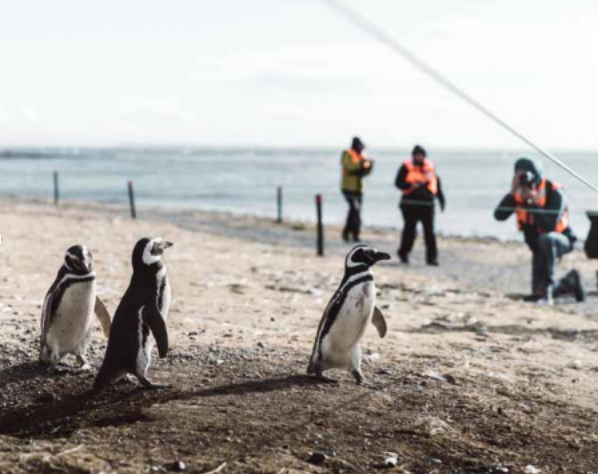
Magdalena Island hosts more than 60,000 breeding pairs of Magellanic penguins during the austral spring and summer. Marked trails pass within metres of active burrows where birds engage in courtship displays, chick-rearing, and the continuous commotion of colony life. The sheer density of penguins — combined with their apparent indifference to human observers — makes this one of the most extraordinary wildlife encounters in all of South America.
Plaza Muñoz Gamero Historic Centre
Punta Arenas's central plaza is framed by the most complete collection of fin de siècle architecture in southern Chile: municipal buildings, private mansions, and a bronze statue of Magellan himself at the centre. Local tradition holds that kissing the foot of his indigenous companion figure brings good fortune to travellers — a ritual observed by generations of passing sailors and now by cruise visitors.
Municipal Cemetery
Among the most celebrated cemeteries in South America, Punta Arenas's cemetery reflects the city's remarkable immigrant heritage through elaborate mausoleums, cypress-lined avenues, and monuments to Croatian, British, and Spanish settlers. The Braun and Menéndez family tombs convey the extraordinary scale of wealth generated by the wool and maritime industries during the city's golden era.
Braun-Menéndez Mansion Museum
Now a regional history museum, this early 20th-century palace preserves the original furnishings and decor of one of Patagonia's most powerful wool-baron families entirely intact. Imported French wallpapers, Flemish tapestries, English silverware, and a private billiard room offer a window into the opulence generated when the Strait of Magellan stood at the centre of global maritime commerce.
Patagonian Steppe Landscapes
The terrain surrounding Punta Arenas is a vast, wind-scoured grassland where low shrubs, thorny calafate bushes, and wheeling condors stretch to a horizon that feels impossibly wide. The scale and silence of this landscape — visible from the city's outskirts within minutes — gives immediate physical context to why Patagonia has captured the imagination of explorers and writers for centuries.
Punta Arenas travel tips
Treat the Wind as a Primary Condition. Punta Arenas wind is genuinely extreme and can be physically challenging. A close-fitting, wind-resistant outer layer is far more effective than a loose jacket that will billow and pull. Secure hats firmly before stepping outside, hold camera straps on the island, and understand that walking against a Patagonian gust is a real physical effort.
Stay on Marked Trails at the Penguin Colony. Magdalena Island has clearly defined trails designed to keep visitors within metres of penguin burrows without disrupting breeding behavior. The penguins appear entirely unbothered by human presence and will approach and walk past you freely — there is no need to move toward them. Step off the trail and you risk both disturbing nesting birds and receiving a firm nip from a penguin defending its burrow.
Layer as if the Forecast Will Be Wrong. Patagonian weather is reliably unpredictable. A warm, clear morning can become a cold sleet squall within an hour even in January. Build a proper layering system — moisture-wicking base, insulating mid-layer, and a fully waterproof and windproof shell — and wear it every time you go ashore. Avoid denim and heavy cotton, which become dangerously cold and heavy when wet.
Confirm Magdalena Island Departure Times Early. Boat departures for the island operate on set schedules, and availability is limited. Confirm sailing times and conditions as early as possible after docking. Sea conditions occasionally modify or cancel crossings on very severe weather days — have a city-based itinerary ready as an alternative so a weather cancellation does not strand you without a plan.
Allow Ample Time at the Cemetery. The municipal cemetery is one of the most architecturally and historically significant sites in the city and is free to enter. Allow at least an hour to walk its cypress avenues and examine the mausoleums at a thoughtful pace. It is a 20-minute walk from the central plaza and straightforward to reach on foot from the city center.
Seek Out the Regional Specialties. Punta Arenas is the culinary capital of Chilean Patagonia. Slow-roasted Patagonian lamb — asado de cordero, cooked over an open fire in the traditional gaucho style — and centolla (southern king crab) pulled from the strait are the two dishes that define the local table. Restaurants around the central plaza serve both, at prices that remain reasonable by international standards.
Port Facts Every Cruiser Needs To Know
Punta Arenas shore excursion FAQs
Most cruise ships dock directly at the Punta Arenas pier, which is close to the city center and walkable to the main plaza. Some larger vessels may anchor in the strait and use tenders. Check with your ship's shore excursion desk on arrival to confirm the exact procedure for your sailing.
The Magellanic penguin colony is active from October through March, aligning with the main cruise season for this region. The height of the breeding season — when both adult birds and chicks are most visible at burrows — runs from November through January. By late February, juveniles have begun to fledge and some adults start departing.
The Strait of Magellan is an open-water crossing exposed to Patagonian weather systems, and conditions range from calm to noticeably choppy. Swells can be significant depending on the day. Visitors prone to motion sickness should take appropriate precautions before boarding. Calm crossings are common in settled weather but cannot be guaranteed.
Punta Arenas is considered among the safer cities in southern Chile and has a calm, small-city character. The port area and city center are well-frequented. Standard precautions apply — secure your valuables and stay aware in crowded areas — but the city generally presents a low-key, frontier-town atmosphere rather than a high-pressure urban environment.
Yes. The central plaza is approximately 15 minutes on foot from the pier, and the main historic sites — the plaza, Braun-Menéndez Mansion, and the streets of the historic center — are all within a comfortable walking radius. The municipal cemetery is a further 20 minutes on foot from the plaza, making a full historic tour of the city walkable for most visitors.
A fully waterproof and windproof outer layer is essential, along with an insulating mid-layer, waterproof footwear with grip, and a hat that can be secured against strong wind. Even in summer, conditions on the island and during the crossing can be cold, wet, and very windy. Dress for conditions worse than the morning forecast suggests — in Patagonia, that is nearly always the appropriate approach.
The Strait of Magellan crossing regularly produces sightings of Commerson's dolphins, black-browed albatrosses, giant petrels, and various cormorant species. Andean condors can occasionally be seen over the steppe surrounding the city. Sea lions are sometimes visible near the port area.
Chilean Pesos (CLP) are the local currency. Credit and debit cards are accepted at most city-center restaurants and shops. Carry some cash for smaller purchases, market stalls, and any smaller heritage sites that may not have card terminals. ATMs are available near the central plaza.
The city itself offers a rewarding half-day of exploration: the ornate municipal cemetery, the central plaza with its Magellan statue, the Braun-Menéndez Mansion Museum, and the Nao Victoria Museum — which houses full-scale replicas of Magellan's and other historic vessels — are all excellent alternatives. The restaurant scene around the plaza, particularly Patagonian lamb and centolla, is genuinely worth the visit on its own terms.
Allow a full port day. The boat crossing takes approximately 90 minutes to 2 hours each way, and guided time on the island typically runs 60 to 90 minutes. Combined with boarding and transit, the complete excursion occupies six to eight hours of your time ashore, leaving limited time for additional city exploration on the same day.
Filters
Select a filter to refine results.
Tour Type
Tour Activity
 Cart
Cart
 USD
USD GBP
GBP AUD
AUD EUR
EUR CAD
CAD