



Tours in Punta Del Este


Cruising to Punta Del Este in a group?
Skip the crowded ship excursion bus. One dedicated planner will design a private shore experience around exactly what your group wants — coordinated from first enquiry to the moment you're back on board. More memorable, more flexible, and more affordable than you might expect. Spend less time organising, more time enjoying.
Explore Group Travel →Cruising to Punta Del Este
Punta del Este occupies a slender peninsula where the Río de la Plata's tawny currents dissolve into the steel-blue Atlantic, and that meeting point captures something essential about the city itself — two worlds converging at a dramatic edge. For most of the year it is a prosperous, quietly sophisticated Uruguayan resort town; in January and February the Southern Hemisphere's elite arrive in force and the pace shifts entirely. Cruise visitors enjoy the best of both: the architecture, the art, and the coastline without the high-season crush. The city's most recognized icon is La Mano, the colossal sculptural hand rising from the sands of Playa Brava, but its deeper pleasures are more lasting — long esplanades canopied by umbrella pines, a working fishing harbor that has changed little in generations, and an art scene of unexpected seriousness. The Ralli Museum presents a remarkable collection of surrealist Latin American and European masters in rooms that feel more like a private collector's home than a formal institution. Further west along the coast at Punta Ballena, Casapueblo — the sprawling whitewashed cliffside creation of artist Carlos Páez Vilaró, built over decades without a blueprint — stands as one of South America's most singular artistic achievements, part studio, part hotel, part living sculpture above the sea. Together they ensure a day in Punta del Este is considerably richer than a beach visit.
Top things to do in Punta Del Este on a cruise stopover
Casapueblo — A Lifetime Built in White
Perched on the cliffs of Punta Ballena with the Atlantic crashing below, Casapueblo defies easy categorization. Built by Uruguayan artist Carlos Páez Vilaró over more than four decades — entirely without architectural plans — the structure grew organically from a simple studio into a labyrinthine complex of domed rooms, terraces, and galleries that seems to have been shaped by wind rather than human hands. Today it functions as a boutique hotel, museum, and working archive of Páez Vilaró's paintings and sculpture. The approach alone — arriving to see that sweep of white plaster spilling down the cliffside — is one of the more memorable visual moments in South American travel.
The Ralli Museum — Surrealism by the Sea
Housed in a quietly elegant villa in the Cantegril district, the Ralli Museum is one of a small network of institutions founded by Chilean collector Harry Recanati to bring surrealist art to unexpected corners of the world. Punta del Este's collection spans major Latin American surrealists alongside European masters including Dalí and Magritte, arranged in intimate gallery rooms and sculpture gardens that feel genuinely personal. For visitors who associate beach resorts with shallow pleasures, the Ralli is a persuasive argument to the contrary — it is a serious collection in a serious setting, free to enter.
La Mano and Playa Brava
No arrival in Punta del Este feels complete without encountering La Mano — Chilean sculptor Mario Irarrázabal's five concrete fingers emerging from the sand of Playa Brava as though a figure is sinking beneath the surface. The image has become the city's defining symbol, but the broader beach experience deserves equal attention. Playa Brava faces the Atlantic directly and carries real surf; the Rambla, the long coastal promenade running its length, is an ideal place to read the city's social fabric — joggers, dog-walkers, and elderly residents sharing the same sea air regardless of season.
The Old Fishing Port — Working Harbor in a Resort City
A short walk from the glossy marina lies the Puerto, where the city's working fishing fleet still operates much as it did before the resort era began. Colorful wooden boats crowd the quays, fish is sold direct from the boats in the early morning, and the restaurants lining the port serve some of the most straightforward, honest seafood in the city. It is a useful reminder that beneath Punta del Este's polished surface, an older, more pragmatic Uruguay persists.
Peninsula Esplanade and Punta del Este's Two Beaches
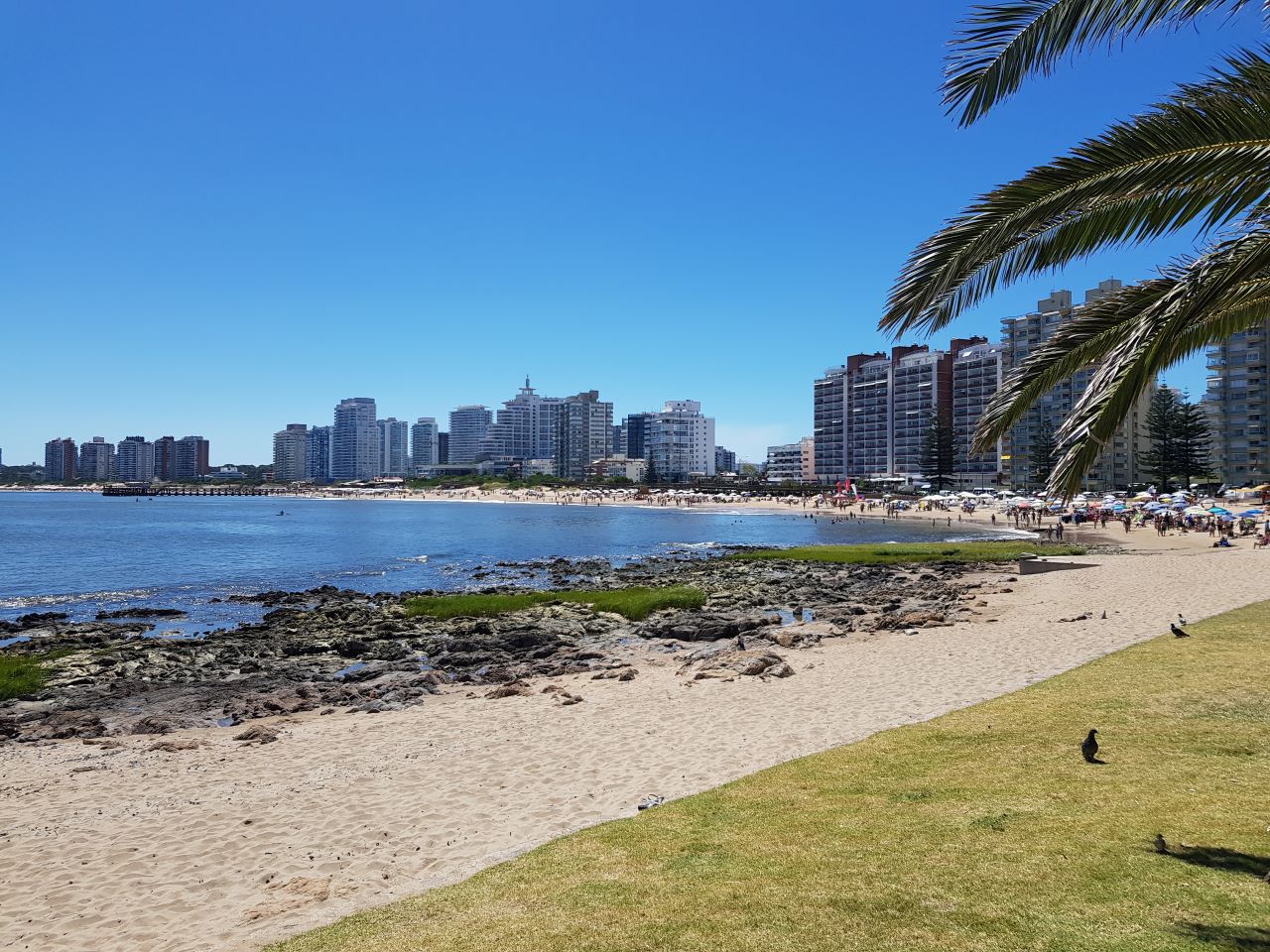
One of the pleasures of the peninsula's geography is that Playa Mansa and Playa Brava — the calm bay beach and the rough Atlantic beach — sit within walking distance of each other, separated by just the width of the land. Playa Mansa's sheltered waters are ideal for swimming; Playa Brava's rolling surf is better for watching than entering. The pine-shaded esplanade connecting them through the town center is Punta del Este at its most unhurried, and a walk along it in either direction takes in the architecture of the resort's golden years alongside the natural edge of South America.
Uruguayan Parrilla — Beef as Cultural Expression
Uruguay rivals Argentina in its devotion to grilled beef, and Punta del Este's restaurant scene takes the tradition seriously without pretension. A parrilla lunch — slowly grilled cuts served with chimichurri, a simple salad, and Uruguayan wine — is as fundamental a cultural experience here as visiting any museum. The port restaurants do it simply and well; the Brava-facing establishments add ocean views to the equation. Reservations are rarely needed at lunch outside peak season, but arriving promptly at noon beats the local rush.
Punta Del Este travel tips
Protect Against the Southern Hemisphere Sun. The ozone layer over southern South America is significantly thinner than in the Northern Hemisphere, and UV levels on the beaches and esplanade can reach extreme levels even on hazy days. Apply high-SPF sunscreen before leaving your ship, bring quality sunglasses, and keep a hat accessible. This applies year-round, not only in summer.
Time Your Casapueblo Visit Strategically. Casapueblo draws its largest crowds at sunset, when the property stages a nightly 'sunset ritual' that has become a travel-social-media fixture. If crowds are not your preference, aim to arrive in the early-to-mid afternoon to explore the galleries and terraces in relative peace, then decide whether to stay for the spectacle or depart before the buses fill.
Confirm the Ralli Museum Before You Arrive. The Ralli Museum is closed on Tuesdays and operates by reservation during limited hours. Before your ship's arrival, verify that your visit date falls within operating hours and that entry is available. The museum is free, but showing up unannounced risks finding the gates closed — a frustrating outcome given the quality of what is inside.
Carry Small Denominations. While credit cards work seamlessly at most Punta del Este restaurants and shops, the fishing port vendors, bus fares, and smaller cafes in the local neighborhoods operate primarily in cash. Carrying a modest supply of Uruguayan pesos in small bills prevents inconvenience when you venture off the main tourist circuit.
Dress for the Season — and for Dinner. In summer, lightweight clothing plus sun protection is all you need during the day. In the shoulder seasons (April–May, September–October), evenings turn genuinely cool and a light jacket is essential. Uruguayans dress with quiet smartness for dining out — moving beyond beachwear for lunch or dinner makes any restaurant experience more comfortable and is simply polite.
Eat on Local Time. Uruguayan lunch runs noon to roughly 3 pm; dinner rarely begins before 8 pm and frequently runs past midnight in high season. Cruise schedules often conflict awkwardly with local meal rhythms. If your ship returns in the late afternoon, prioritize lunch ashore and plan to eat dinner onboard — trying to eat dinner before 7 pm will leave you choosing from a limited pool of tourist-focused establishments.
Port Facts Every Cruiser Needs To Know
Punta Del Este shore excursion FAQs
Yes — the port sits on the peninsula, placing the fishing harbor, Playa Brava, Playa Mansa, the Rambla, and the central restaurant district all within comfortable walking distance. Casapueblo at Punta Ballena requires a bus journey of roughly 12 km and needs more deliberate planning.
Casapueblo is the life's work of Uruguayan artist Carlos Páez Vilaró — a sprawling, organically shaped complex of whitewashed rooms, terraces, and studios built over four decades into the cliffs above the Atlantic at Punta Ballena. Part museum, part hotel, and part working archive of Páez Vilaró's art, it is widely considered one of the most remarkable architectural-artistic creations in South America.
The Ralli Museum is a private art museum housing an outstanding collection of surrealist works — Latin American masters alongside European figures including Salvador Dalí and René Magritte. It is free to enter and set in elegant villa gardens. For visitors with any interest in modern art, it is one of the most genuinely surprising cultural experiences available in a South American beach destination.
Outside January and February (peak summer season), reservations are generally not required for lunch at port-area restaurants. Arriving at noon — when kitchens open — ensures the best selection and service. For dinner at more established restaurants during high season, booking ahead is advisable.
Yes. Playa Mansa on the bay side is calm, warm, and sheltered — ideal for swimming. Playa Brava faces the Atlantic and carries real surf and strong currents; it is better suited for walking and sunbathing than for casual swimming. Lifeguards are present on main beaches during the summer season.
Punta del Este has a well-earned reputation as one of the safest urban environments in South America. The peninsula, the port area, and the main beaches are comfortable to walk independently at any time during daylight hours. Standard urban common sense applies after dark, as in any city.
The local currency is the Uruguayan Peso (UYU), but US dollars are broadly accepted at tourist-facing businesses, restaurants, and attractions. Change is often returned in pesos. For smaller purchases, buses, and vendors at the fishing port, local currency is more reliable. Credit cards work at most established venues.
Casapueblo at Punta Ballena is approximately 12 km west of the port. By local bus it takes roughly 30–40 minutes depending on the route and time of day. Plan for at least two hours at the site itself to do it justice, and factor in return travel when timing against your ship's departure.
More than in most Uruguayan cities. Hotels, established restaurants, major attractions, and tourist-oriented shops all typically have English-speaking staff. Outside these contexts — local cafes, the fishing port, public buses — Spanish is the working language. A translation app is a useful backup.
With limited time, focus on the peninsula itself: walk the Rambla from Playa Mansa to Playa Brava, see La Mano, browse the fishing port, and have a proper parrilla lunch at a port-area restaurant. The Ralli Museum can be added if it is open and you have confirmed entry. Casapueblo warrants a longer day — it deserves time rather than a rushed visit.
Filters
Select a filter to refine results.
Tour Type
Tour Activity
 Cart
Cart
 USD
USD GBP
GBP AUD
AUD EUR
EUR CAD
CAD