



Tours in Quito


Cruising to Quito in a group?
Skip the crowded ship excursion bus. One dedicated planner will design a private shore experience around exactly what your group wants — coordinated from first enquiry to the moment you're back on board. More memorable, more flexible, and more affordable than you might expect. Spend less time organising, more time enjoying.
Explore Group Travel →Cruising to Quito
Quito commands an Andean valley at 2,850 metres above sea level, its skyline formed by a ridge of volcanoes — some dormant, some merely resting — that frame the city on all sides. It is a capital whose elevation shapes everything: the quality of light, the cool spring-like temperature maintained year-round regardless of latitude, and the slightly deliberate pace visitors are well advised to adopt on arrival. Quito served as the northern capital of the Inca Empire before the Spanish established their colonial administration here in 1534, and the resulting layering of civilizations produced a historic center of extraordinary richness. In 1978, UNESCO named Quito and Kraków the world's first two World Heritage Cities, citing the exceptional state of preservation of El Centro Histórico — some 40 churches, convents, and chapels crowded into a compact district of cobbled streets and plazas where the 16th century remains legible in nearly every facade. La Compañía de Jesús, with its entirely gold-leafed interior considered the most ornate baroque church in the Americas, is the non-negotiable centrepiece, but the district rewards wandering as much as ticking off landmarks. For Galápagos cruise travelers overnighting in Quito as part of their itinerary, the city offers a complete counterpoint to the islands — where the Galápagos are raw, volcanic, and elemental, Quito is layered, human, and profoundly historical. And a short distance to the north, the Mitad del Mundo monument marks the equatorial line with the kind of geographic specificity that turns an abstract concept — standing at the very center of the Earth — into a genuinely memorable physical experience.
Top things to do in Quito on a cruise stopover
El Centro Histórico — The Americas' Best-Preserved Colonial City
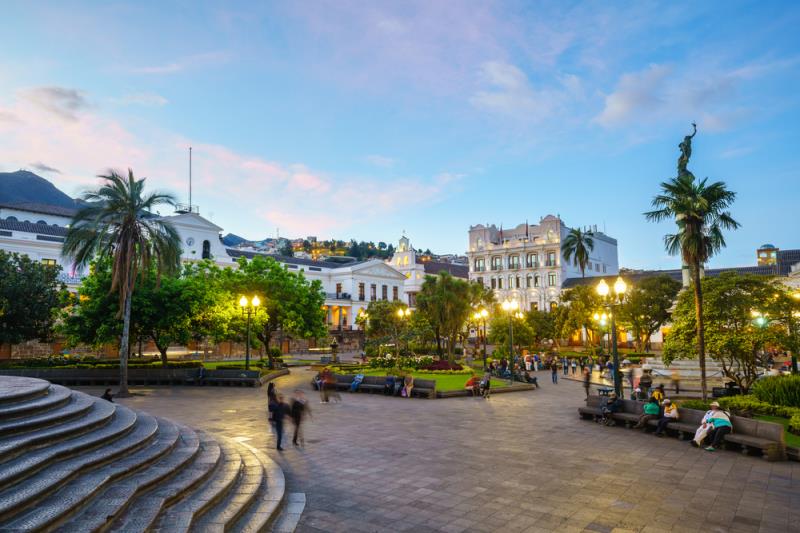
Quito's historic center was among the first places on Earth to receive UNESCO World Heritage designation, and the scale of what that recognition protects is genuinely impressive. More than 40 churches, convents, plazas, and civic buildings from the 16th through 18th centuries survive in a state of preservation that makes walking its cobbled streets feel like inhabiting a living document of colonial South America. The Plaza Grande — flanked by the Presidential Palace, the Cathedral, and the Archbishop's Palace — is the natural orientation point, but the neighborhood's density of significant buildings means almost any direction from there yields something worth pausing at.
La Compañía de Jesús — Seven Tons of Gold in a Single Interior
Of Quito's extraordinary concentration of colonial churches, La Compañía de Jesús stands apart. The Jesuit church, completed in 1765 after 160 years of construction, is considered the most elaborate baroque interior in the Americas — its walls, arches, columns, and altars covered almost entirely in gold leaf, with a density of ornament that takes the eye minutes simply to begin processing. The exterior is equally remarkable, its carved volcanic stone facade representing the peak of the Quito School of art and architecture. Entry is ticketed and managed by timed visits; queues can be significant mid-morning.
Journey to the Middle of the World — The Equatorial Line
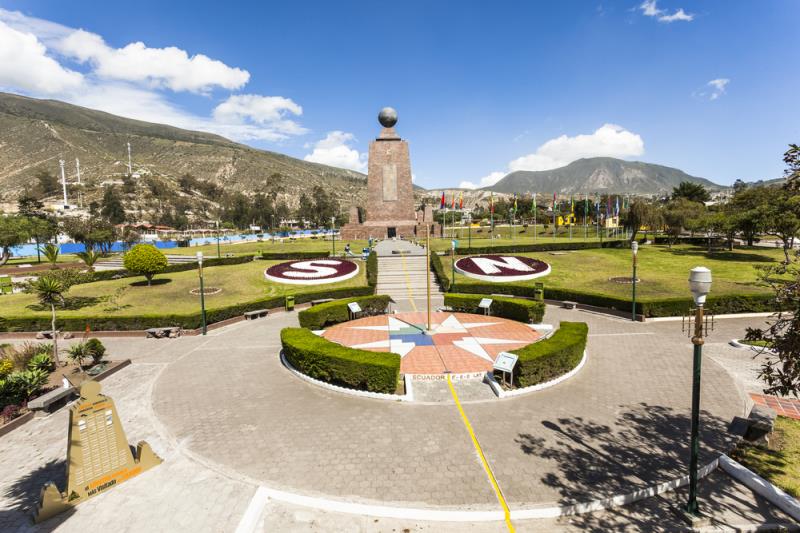
Approximately 25 km north of central Quito, the Mitad del Mundo complex marks the equatorial line with a monument, a museum, and the kind of experiential geography that rarely exists outside textbooks. Standing with one foot in the Northern Hemisphere and one in the Southern, watching water drain without a spiral above the equator, and understanding — even briefly — one's precise position on the surface of the planet, is more viscerally engaging than it sounds. The nearby Intiñan Solar Museum adds ethnographic and scientific depth to the site, with demonstrations of equatorial phenomena.
El Panecillo — The Hill at the Center of Everything
A small volcanic hill rising from the center of the city, El Panecillo is crowned by a massive aluminum statue of the Virgin of Quito — a winged interpretation of the original in La Iglesia de San Francisco — visible from almost everywhere in the city below. The hilltop offers a panoramic 360-degree view of Quito's full extent: the colonial center, the modern city sprawling northward, and on clear days the volcanoes — Pichincha, Cotopaxi, and others — ringing the valley. The view is best before noon when clouds typically remain thin.
Quito's Markets and Andean Culinary Culture
The Mercado Central in the historic district and the Mercado Iñaquito further north offer the most direct encounter with Quito's food culture — stalls of highland produce, fresh juice bars serving Andean fruits rarely seen outside Ecuador, and comedores (simple lunch counters) where caldo de gallina (chicken broth) and llapingachos (potato cakes) are served to office workers and market vendors side by side. Quito's contemporary restaurant scene, concentrated in the La Mariscal and González Suárez districts, adds a more refined layer to the same Andean ingredients.
The Teleférico — Rising to the Flanks of Pichincha
Quito's aerial cable car ascends from 2,950 metres at its base station to 4,100 metres on the flank of Volcán Pichincha — high enough that the air is noticeably thinner still, the city below is reduced to a grid of light, and condors occasionally drift past at eye level. The Teleférico operates on the western edge of the city and provides some of the most dramatic perspectives available without a mountaineering permit. Early morning offers the clearest skies and the best odds of seeing surrounding volcanoes before afternoon cloud builds.
Quito travel tips
Treat Altitude With Genuine Respect. Arriving in Quito at nearly 2,850 metres is the most significant physical variable of any visit, and first-time visitors underestimate it at their own expense. Drink significantly more water than usual, avoid alcohol for the first 24 hours, eat lightly, and build rest breaks into your day. Symptoms — a dull headache, mild breathlessness, unusual fatigue — are very common and typically ease by the second half of your first day. If symptoms are severe or include chest tightness, consult medical assistance promptly.
Layer Everything. Quito's temperature swing between midday and evening is substantial — 15–20°C in direct sun can become 8–10°C within an hour of dusk. A packable down or fleece layer worn under a windproof outer shell handles the full range. Mornings in shaded streets can feel genuinely cold; afternoons in open plazas can be warm enough for a single layer. Always carry the layers rather than leaving them at the hotel.
Wear Sunscreen at All Times. The combination of equatorial latitude and high altitude makes Quito's UV index one of the highest of any major city on Earth. A pleasant 18°C afternoon with partial cloud cover can still deliver severe sunburn on exposed skin. Apply broad-spectrum SPF 50 sunscreen before leaving your hotel regardless of the forecast, and reapply after any period outdoors. Sunglasses are equally important — UV levels at altitude are significantly elevated compared to sea level.
Start Mornings in the Historic Center. El Centro Histórico is at its most photogenic and least crowded in the first two hours after opening — roughly 8 to 10 am. The light on the carved stone facades is extraordinary in the morning, queues at La Compañía are manageable, and the human energy of the market stalls and commuters adds texture without overwhelm. By midday the district becomes significantly more crowded, and school groups arrive in force.
Use Small Bills in Markets. Ecuador's dollar economy runs on small denominations in its markets, street food stalls, and neighborhood shops. Vendors at the Mercado Central and Iñaquito frequently cannot change bills larger than ten dollars for small purchases. Withdraw smaller bills if using an ATM, or break larger notes at hotel counters or supermarkets before heading to any market.
Dress Modestly for Church Visits. Quito's major churches — La Compañía, San Francisco, La Merced — remain active places of worship as well as tourist destinations. Covered shoulders and knees are expected in most of them. Some churches restrict or charge for photography; confirm the policy at the entrance rather than assume. La Compañía prohibits photography inside entirely, but the experience of standing in its interior needs no photograph to remain vivid.
Port Facts Every Cruiser Needs To Know
Quito shore excursion FAQs
Quito serves as the primary gateway for Galápagos Islands cruises and some expedition itineraries that include mainland Ecuador. Many cruise lines include one or two nights in Quito before or after the sea journey, and Venture Ashore's tours are designed specifically for guests with hotel time in the city as part of their broader cruise package.
Meaningfully, for most people — though not dramatically for the majority. At 2,850 metres, the air contains roughly 25% less oxygen than at sea level. Breathlessness when climbing stairs, a mild headache, and unusual fatigue are very common in the first several hours. These symptoms typically ease significantly by the end of the first day. Staying hydrated and moving at a relaxed pace is the most effective way to acclimatize. Visitors with cardiac or respiratory conditions should consult their physician before traveling to high altitude.
Mitad del Mundo — 'Middle of the World' — is a monument and museum complex 25 km north of central Quito marking the equatorial line at 0° latitude. The main monument is a large stone obelisk topped by a globe, flanked by a museum on Ecuador's geographic and cultural heritage. The nearby Intiñan Solar Museum conducts interactive demonstrations of equatorial phenomena and is generally considered the more engaging of the two facilities.
Most hotels serving Galápagos cruise travelers are located in Quito's modern districts — La Mariscal, González Suárez, or the airport corridor. From La Mariscal and González Suárez, the historic center is approximately 3–5 km south, well connected by the city's Trolleybus and Metro lines. Journey times are typically 20–30 minutes by public transport.
The main tourist circuit of the historic center — Plaza Grande, La Compañía, Plaza San Francisco, and the surrounding streets — is well-trafficked, patrolled by tourist police (Policía Metropolitana), and considered safe during daylight hours. As evening approaches, it is advisable to move to the Mariscal or modern restaurant districts. The standard precautions of any large city apply: keep valuables out of sight and remain aware of surroundings.
La Compañía de Jesús is the non-negotiable starting point — its entirely gold-leafed baroque interior is unlike anything else in the Americas. San Francisco is the largest colonial religious complex in the city and worth considerable time for its courtyards and museum. La Merced and Santo Domingo each have notable interiors. If time is limited, La Compañía followed by the plaza and exterior of San Francisco covers the essential ground.
Andean highland cuisine is the local specialty. Llapingachos (pan-fried potato and cheese cakes served with peanut sauce and chorizo), caldo de gallina (rich chicken broth with potatoes and herbs), seco de pollo (braised chicken stew), and ceviche de camarón (shrimp ceviche, distinct from coastal Peruvian versions) are all worth trying. Fresh-pressed juices from Andean fruits — naranjilla, tomate de árbol, taxo — available at any market juice counter, are among the best things you will drink in Ecuador.
The essential kit: layered clothing (a base layer, a mid-layer fleece or down jacket, a windproof outer layer), comfortable walking shoes suitable for cobblestones, SPF 50 sunscreen, quality sunglasses, and a small daypack. A compact umbrella or light rain jacket is useful in the wet season. Do not underestimate the cold — even on warm-looking sunny afternoons, finding shade or a passing cloud can drop the felt temperature significantly.
Yes, comfortably — this is one of Quito's standard full-day itineraries. The key is sequencing: start in the historic center in the morning when light and energy are best, then travel north to Mitad del Mundo for the early afternoon. Allow at least two hours at the Mitad del Mundo complex to do both the main monument museum and Intiñan adequately. Returning to the city by mid-afternoon leaves time for a leisurely dinner in the Mariscal district.
Ecuador uses the US dollar. ATMs are widely available in modern districts and at the airport; Banco Pichincha, Banco Guayaquil, and international network ATMs at shopping centers are the most reliable. In the historic center, ATM access is more limited — withdraw cash in your hotel district before heading to the old city. Carry small bills for markets and street purchases; large bills are difficult to change at local vendors.
Filters
Select a filter to refine results.
Tour Type
Tour Activity
 Cart
Cart
 USD
USD GBP
GBP AUD
AUD EUR
EUR CAD
CAD